

Have you ever experienced a sense of overwhelm, feeling out of control, or suddenly felt anxious in response to something that typically wouldn’t be an issue?
Maybe it was a message from your boss, in interaction with a colleague, or simply one more thing added to an already busy day. On another occasion you may have handled the exact same situation without much difficulty at all, yet this time it suddenly felt like too much.
Experiences like this often confuse people because the reaction can feel disproportionate to what is actually happening. We start wondering why we are reacting this way, why we cannot seem to think clearly or why everything suddenly feels heavier than it should.
Sometimes we don’t even notice it happening at all. We become so mentally involved in the situation, the thoughts and the feelings surrounding it, that everything simply starts feeling like too much. Often the response is to push harder, keep going and try to force ourselves through it, while quietly carrying the feeling that we should be coping better than we are.
But if you observe your own experience carefully enough, you start noticing something important. The exact same situation can feel completely different depending on the state your mind and nervous system were already in before it happened.
Psychiatrist Dan Siegel described this through the idea of the “Window of Tolerance”, the range in which the nervous system is regulated enough for us to think clearly, respond effectively and remain present with what is happening rather than becoming consumed by it.
Inside that window there is more psychological space available. Thoughts still appear, emotions still arise and pressure still exists, but there is enough capacity in the system for perspective, flexibility and choice to remain accessible. Outside that window the mind becomes louder, reactions become faster and even relatively minor problems can begin feeling unusually personal, urgent or emotionally overwhelming.
What narrows the window is often not the single event we blame in the moment, but the accumulation that has been building quietly underneath the surface.
Poor sleep gradually reduces resilience. Constant mental engagement keeps the nervous system activated. Background worry, emotional tension, overstimulation, sustained responsibility without proper recovery and the endless habit of mentally revisiting problems all slowly add load to the system.
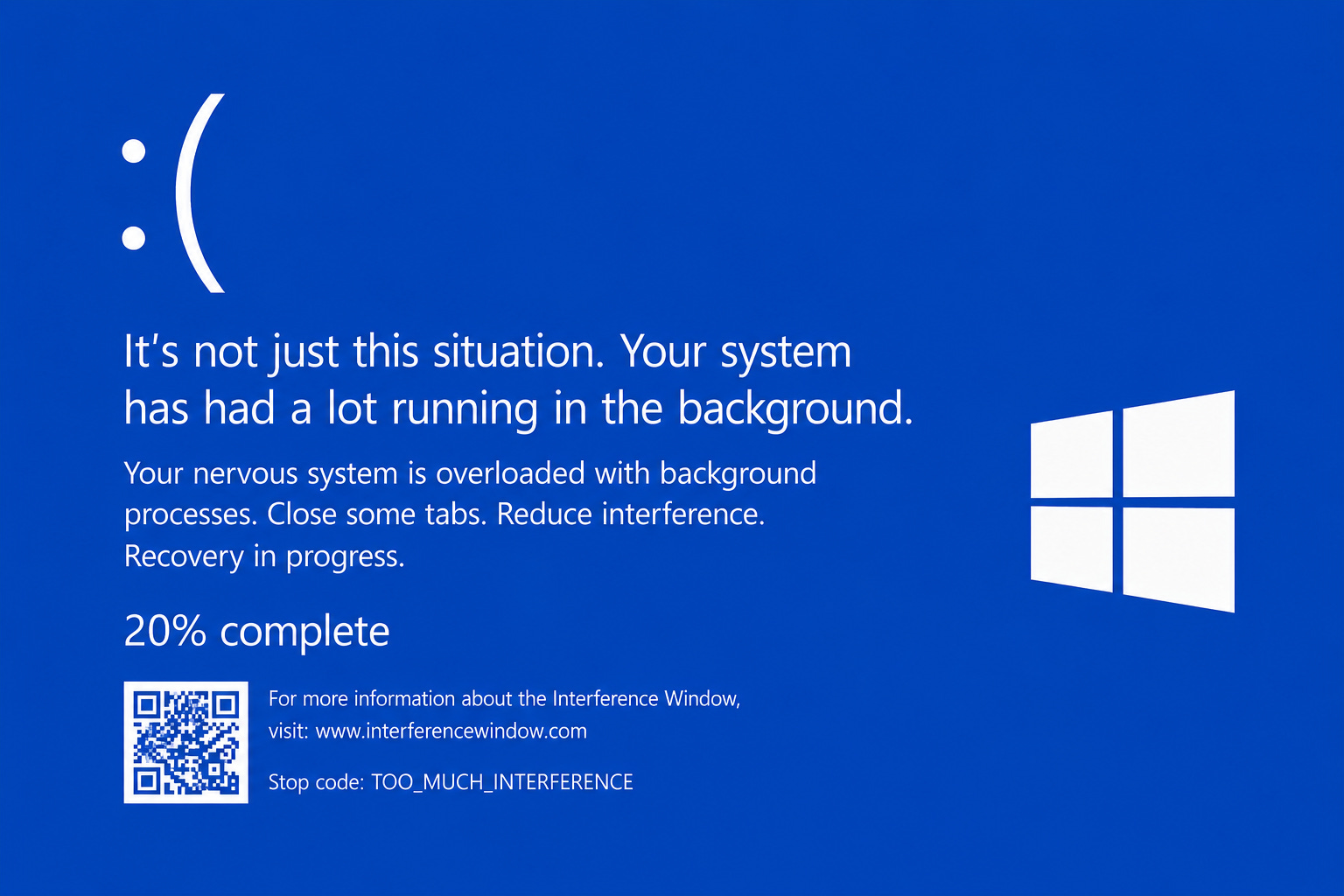
It’s similar to trying to run too many applications on a computer at the same time. At first everything still appears functional, but the processing capacity gradually becomes stretched thinner and thinner in the background until eventually something small causes the entire system to slow down or freeze. Most people focus only on the final moment the system struggles, while rarely noticing the enormous amount already running underneath it.
This is one reason why thinking itself can become such an important part of stress. The mind keeps reopening loops, replaying conversations, predicting outcomes and trying to mentally solve situations that cannot yet be solved. Even while sitting still, the body can remain subtly prepared for threat because the mind never fully steps out of the struggle.
Then one more email arrives, one more inconvenience appears or one more interaction feels difficult and suddenly the reaction seems far bigger than the situation itself would appear to justify.
Usually it’s not about that single moment at all. It’s about everything the system has already been carrying before the moment arrived.
This is where awareness becomes incredibly useful. Instead of immediately believing something has gone terribly wrong, or telling yourself you should be handling things better, simply notice what is happening. Notice that your system has had a lot running in the background. Notice the thoughts, the tension and the feelings that are there without trying to immediately fix or judge them. That’s often enough.
Because the moment you stop fighting the fact that stress is happening, a little more space starts to open up around the experience. And from that space, things often begin settling far more naturally than when the mind is trying to force its way back into control.